Look Beyond the Headlines This Reporting Season
Every August, reporting season puts Australia's largest listed companies under the microscope. Over a matter of weeks, investors are flooded with company results, market commentary and often significant share price movements.
It is easy to focus on whether a company has beaten or missed expectations, but the headline result rarely tells the full story. The real value lies in understanding what is driving performance, how sustainable that performance is and what it means for the future.
A strong result supported by one-off factors may not be as impressive as it first appears, while a disappointing result can sometimes mask a business with solid long-term prospects. Successful investors look beyond the noise, focusing instead on the quality of the business, its financial strength and its outlook.
Before drawing conclusions, here are seven things worth paying close attention to this reporting season.
Earnings Revisions
Earnings revisions can often tell investors more than the reported result itself. While headline numbers reflect the past, changes to analyst forecasts provide insight into future expectations.
Companies experiencing consistent earnings upgrades tend to attract market support, while repeated downgrades can signal that confidence is beginning to weaken. An earnings beat may therefore be less important than whether expectations for future earnings are rising or falling.
Quality of Earnings
Not all earnings are created equal. During reporting season, investors should look beyond reported profit and assess how those earnings were generated.
Strong cash flow, recurring revenue and sustainable operating performance can provide greater confidence than earnings boosted by one-off events, asset sales or accounting adjustments. High-quality earnings are generally more likely to be repeated in future reporting periods.
Operating Performance
Strong businesses do more than grow earnings. They generate attractive returns, improve profitability and deploy capital efficiently over time.
When reviewing results, focus on whether key metrics such as revenue growth, profit margins, return on equity and earnings growth are strengthening or weakening. These trends can help determine whether a company is genuinely creating shareholder value.
It is also important to consider how performance compares with the company's history and its industry peers. A company may report growth, but that growth is more meaningful when it is accompanied by improving margins, efficient capital allocation and attractive returns.
Management Outlook
Reporting season is not just about what has happened. It is also about what comes next.
Management commentary can often have a greater impact on share prices than the reported result itself. Pay close attention to guidance, demand trends, cost pressures, margin expectations and any change in management's tone.
Markets are forward-looking, and outlook statements help shape future expectations. A company that reports strong historical results but provides cautious guidance may face greater pressure than a business with a weaker past result but improving conditions ahead.
Emerging Risks
Every investment carries risk, but reporting season can reveal whether those risks are increasing or becoming more manageable.
Look for commentary around competitive pressures, regulatory changes, customer demand, staffing challenges, supply chain issues and broader economic conditions. Understanding the risks facing a business can be just as important as understanding its opportunities.
Investors should also consider whether management is clearly identifying these risks and taking practical steps to manage them. Increasing risks, limited mitigation strategies or a lack of transparency can be warning signs.
Financial Flexibility
Even profitable businesses can face challenges if their financial position comes under pressure.
Consider whether debt levels remain manageable, whether interest costs are rising and whether the company has sufficient flexibility to fund growth and navigate changing market conditions.
Financially resilient businesses are often better placed to withstand uncertainty. Strong balance sheets can provide the flexibility to invest through difficult periods, while highly indebted companies may be forced to reduce spending, raise capital or sell assets at an unfavourable time.
Share Price Reaction Versus Fundamentals
A sharp share price move is not always a reflection of a company's underlying performance.
Before reacting to market volatility, ask whether the result has genuinely changed the investment thesis. In many cases, short-term sentiment can drive significant share price movements even when the long-term outlook for the business remains largely unchanged.
Rather than focusing solely on the immediate share price reaction, consider whether the company's financial health, performance, earnings expectations and outlook have materially improved or deteriorated.
Where Stock Doctor Fits In
Reporting season can generate an overwhelming amount of information in a short period of time. While every company result is different, the principles used to evaluate them often remain the same.
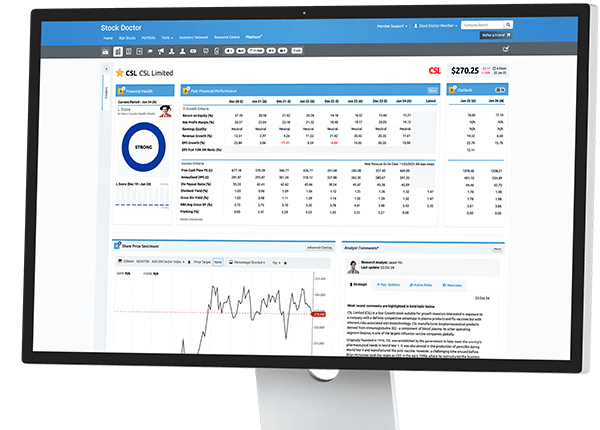
At Stock Doctor, we simplify the process by focusing on three core pillars that help investors look beyond the headlines and assess what really matters: financial health, financial performance, and outlook and active risks.
These three areas form the foundation of our investment framework and provide a structured approach to analysing companies during reporting season and beyond.
Golden Rule #1: Financial Health
The Financial Health model is the foundation of Stock Doctor's investment framework.
Before assessing growth potential, investors should first understand whether a company's financial position is strong enough to support future performance. Factors such as earnings quality, cash flow and balance sheet strength can help identify businesses that are financially resilient and better positioned to navigate changing market conditions.
A company with strong financial health may have greater capacity to manage uncertainty, invest in future growth and withstand temporary pressure on earnings.
Golden Rule #2: Financial Performance
Strong companies do not just survive; they consistently deliver results.
Financial Performance focuses on measures such as profitability, capital efficiency and earnings growth. By analysing these key metrics, investors can identify companies that are creating value for shareholders and demonstrating the ability to sustain their performance over time.
Looking at performance trends can also help investors distinguish between temporary improvements and businesses that are steadily strengthening their underlying operations.
Golden Rule #3: Outlook and Active Risks
Understanding a company's prospects is just as important as understanding its past results.
This involves assessing management commentary, industry conditions and the key risks that could influence future performance. Reporting season often provides valuable insights into changing business conditions, helping investors evaluate whether a company's outlook remains on track.
By considering both potential opportunities and active risks, investors can develop a more balanced view of what may influence a company's future results.
Applying these principles across hundreds of company announcements can be time-consuming. That is where Stock Doctor's research tools can help.
Financial Health Ratings help investors quickly assess balance sheet strength, earnings quality and cash flow sustainability.
Financial Performance Measures highlight companies demonstrating strong profitability, capital efficiency and earnings growth.
Outlook and Active Risk Analysis provides insight into management guidance, business risks and factors that could influence future performance.
Stock Doctor does not make investment decisions for you, but it can help investors apply a more disciplined, evidence-based approach to reporting season by focusing on the factors that matter most.
Ready to Cut Through the Noise This Reporting Season?
Reporting season creates plenty of noise, but successful investing often comes down to focusing on the factors that truly drive long-term performance.
By looking beyond the headlines and applying a disciplined framework, investors can navigate results season with greater clarity and confidence.